I deeply believe in the power of setting goals. But not too many. And not impossible ones.
Few goals. Clear, realistic, and aligned with your personality and your personal rhythm.
As a Neurolanguage Coach who supports Spanish speakers on their journey with Italian, I have seen time and again that the brain learns better when it is calm. And calm does not appear by magic: we build it when we know where we are going.
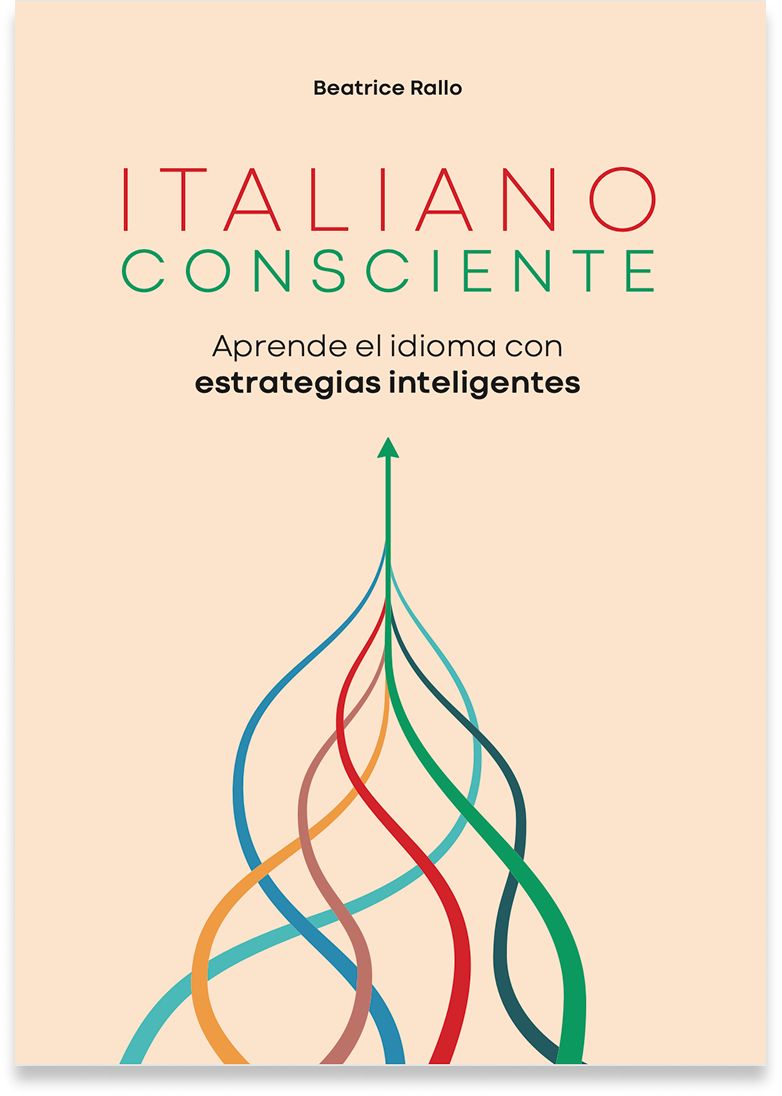
In my book Italiano Consciente, I dedicate an important section to this: understanding how our brain thrives on clarity, how it functions much better when it does not feel overwhelmed, and how learning becomes deeper when we leave urgency behind and embrace coherence.
Calm comes when your goals are clear and achievable.
And from there, everything changes.
Two types of goals to move forward with balance
In my sessions, we always work from two complementary dimensions: mechanics and mastery.
Because learning Italian is not only about understanding structure…
and it is not only about “just starting to speak.”
We need both wings to fly.
1️⃣ Mechanical goals: clarity and structure
Mechanical goals give us foundation, order, and confidence.
Here we work on grammar, sentence structure, and accuracy.
But not through automatic memorization—rather through conscious understanding.
Here are some of the questions I use to help you set coherent and concrete mechanical goals:
- What grammatical structure do I want to master at this stage (for example, past tense, prepositions, pronouns)?
- When I build a sentence, where do I feel the most hesitation?
- Am I translating literally from Spanish? What would the natural Italian structure be?
- Which mistakes tend to repeat most often in my expression?
- Which grammatical pattern do I need to practice to feel more stable?
- How can I transform the same sentence into different verb tenses?
- Which resource helps me consolidate this structure best (written exercises, oral repetition, real examples, mini dialogues)?
These questions allow us to define a concrete goal.
For example:
“I don’t want to study all past tenses. I want to feel confident using the passato prossimo in everyday conversations.”
That is realistic. That creates calm. That is measurable.
2️⃣ Mastery goals: identity and communication
Here we enter a deeper dimension.
Because speaking Italian is not just about speaking correctly. It is about feeling that your message represents who you are.
Mastery questions aim to connect the language with your real life:
- In which real-life situations do I want to feel more comfortable speaking Italian?
- Why am I learning Italian at this moment in my life?
- What kind of conversations do I want to be able to hold (professional, personal, academic, travel)?
- Which vocabulary do I need most urgently according to my environment?
- Which part of my personality do I feel I still cannot express in Italian?
- What would make me feel proud of my level within three months?
- What are my strengths when communicating, and how can I enhance them in Italian?
Here, the goal stops being “improving my Italian” and becomes something much clearer:
“I want to be able to present my professional project in Italian with confidence.”
“I want to maintain a fluent conversation with my partner’s family.”
“I want to feel natural when I travel.”
That is mastery.
From goals to action: your personalized plan
Once we define your mechanical and mastery goals, we design concrete actions adapted to your way of learning.
Because every brain is different.
Some people need written structure. Others need guided conversation. Others benefit from conscious repetition. Others need to deeply understand before speaking.
In my sessions, we focus on the “how to get there.” Not only on the result, but on the process.
The conscious linguistic immersion plan
Once we have clarity, I also support you with a personalized and guided linguistic immersion plan.
A realistic plan. Integrated into your routine. Sustainable over time.
We create conscious habits so that Italian begins to sound natural. So that it stops being a pending task and starts becoming part of your identity.
This approach is deeply inspired by my book Italiano Consciente, where I explain how to integrate the language through calm, coherence, and respect for your own rhythm.
Because when your brain is calm, it learns better. And when your goals are realistic, you move forward with confidence.
Italian is not conquered through pressure. It is integrated through awareness.
And I will be delighted to accompany you on that journey. 💛